Rosslyn Chapel
Oct. 2nd, 2008 08:57 pm![[personal profile]](https://www.dreamwidth.org/img/silk/identity/user.png) rhythmaning
rhythmaningBack in April, we were going to visit Rosslyn Chapel; since I had a car for a day after getting back from Islay, I took myself down there.
It is at least twenty five years since I was last at Rosslyn – strange to wait so long to go back. I first went down to Rosslyn Castle – the chapel wasn’t open yet. The castle, high over the glen. It was a dramatic spot. The old sandstone was heavily weathered – very beautiful in the morning light.
One isn’t allowed to take photographs within the chapel itself; surprisingly, this didn’t really bother me (and I didn’t object to having to pay almost as much as I had baulked at when asked to pay to go into St Paul’s Cathedral: maybe I was just feeling in a better mood, more happy to help support an ancient place of worship). The chapel’s website covers lots of the things I would have photographed. And I found these on Wikipedia with creative commons licences:
It really is a fascinating building – allegedly the oldest extant Gothic church (although whether in Scotland or the UK I can’t remember…!). The carvings are phenomenal: completely captivating. It is as if every bit of stone that could support a carving had been carved: pillars, bosses, ribs. The ceiling is spectacular. The interior is crowded with symbolism – for those of you not familiar with The Da Vinci Code (like me – I’ve not read it), the chapel was built by Sir William St Clair (nowadays this would be Sinclair), who is believed to have been one of the Knights Templar and a mason. There are also a very great many “Green Man” carvings, both inside an outside the chapel.
There is a family tree for the St Clairs: they were Norman knights who were part of the 1066 invasion and settled in Scotland where they acquired lots of land – they became Lords of Caithness, Earls of Orkney, and found time to acquire half of Midlothian. Most of them seem to have been called Sir William, so they went by nicknames: I was taken by “William the Seemly” and “William the Waster”.
The chapel is being dried out; it is covered by a large tarpaulin, supported by a free-standing scaffolding structure – which one can climb. This is part of a large scale renovation project. The carving inside are in very good condition – I asked whether they had been renovated or replaced – many look as good as new – and I was told not: some were simply made with very high quality stone, and they still look new, whilst others were made out of weaker sandstone, and are crumbled.
It is a different situation outside, though: much of stonework is in a poor condition.
It is at least twenty five years since I was last at Rosslyn – strange to wait so long to go back. I first went down to Rosslyn Castle – the chapel wasn’t open yet. The castle, high over the glen. It was a dramatic spot. The old sandstone was heavily weathered – very beautiful in the morning light.


One isn’t allowed to take photographs within the chapel itself; surprisingly, this didn’t really bother me (and I didn’t object to having to pay almost as much as I had baulked at when asked to pay to go into St Paul’s Cathedral: maybe I was just feeling in a better mood, more happy to help support an ancient place of worship). The chapel’s website covers lots of the things I would have photographed. And I found these on Wikipedia with creative commons licences:

The Apprentice Pillar – photo: Guinnog
Carvings of corn (made before Columbus discovered the Americas) – photo: Kjetil Bjørnsrud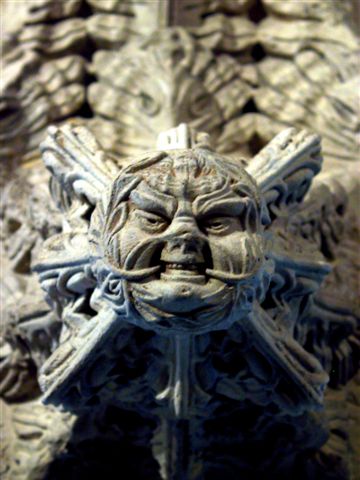
Green Man carved boss – photo: Johanne McInnis
Sir William Sinclair carrying the heart of Robert the Bruce to the Holy Land – photo: Otter
It really is a fascinating building – allegedly the oldest extant Gothic church (although whether in Scotland or the UK I can’t remember…!). The carvings are phenomenal: completely captivating. It is as if every bit of stone that could support a carving had been carved: pillars, bosses, ribs. The ceiling is spectacular. The interior is crowded with symbolism – for those of you not familiar with The Da Vinci Code (like me – I’ve not read it), the chapel was built by Sir William St Clair (nowadays this would be Sinclair), who is believed to have been one of the Knights Templar and a mason. There are also a very great many “Green Man” carvings, both inside an outside the chapel.
There is a family tree for the St Clairs: they were Norman knights who were part of the 1066 invasion and settled in Scotland where they acquired lots of land – they became Lords of Caithness, Earls of Orkney, and found time to acquire half of Midlothian. Most of them seem to have been called Sir William, so they went by nicknames: I was taken by “William the Seemly” and “William the Waster”.
The chapel is being dried out; it is covered by a large tarpaulin, supported by a free-standing scaffolding structure – which one can climb. This is part of a large scale renovation project. The carving inside are in very good condition – I asked whether they had been renovated or replaced – many look as good as new – and I was told not: some were simply made with very high quality stone, and they still look new, whilst others were made out of weaker sandstone, and are crumbled.
It is a different situation outside, though: much of stonework is in a poor condition.


I had a wonderful visit: I thought the chapel was as much of a special place as everyone has always told me it is.