Friday in London: Art, and Stuff
Nov. 23rd, 2006 05:17 pm![[personal profile]](https://www.dreamwidth.org/img/silk/identity/user.png) rhythmaning
rhythmaningI really wanted to see that exhibition, so I phoned the gallery; I wanted to make sure that if I went back there, I would be able to get in. The woman on the phone assured me the gallery had been open the day before - she had obviously not tried to find the way in. And then it was onto the tube to go back to Latimer Road. The way the tubes worked, I actually went to Holland Park (on the Central line; this is relevant, believe me) and walked north, past the Georgian houses, past the tower blocks, and back to the gallery.
This time, they let me in. I was prepared to be angry at them for not letting me in the day before. Except that it immediately felt like a great place. This may have been down to the welcoming committee: the main criterion for employment in gallery was clearly to be female and attractive, and in your early twenties. And tall, and blonde. Perhaps they hired female art students or something. There were more female employees there than there were visitors; wherever I went, one of them would appear. (This was probably because I asked if I could take photographs; and they said no - well, they said not of the artwork, only the building.) It cost £10 to get in - which I thought was a bit steep, but then someone has to pay for all those blondes to follow me around.
The exhibition was a retrospective of James Turrell's work. I first came across him at an exhibition at the Hayward Gallery; I hadn't gone to see his stuff, but his show was on, and the ticket let me see his work too. Keen to get my money's worth, I went to see his show as well as whoever's exhibition I had meant to see. (Richard Long? Howard Hodgkin?) I was fascinated. My main recollection of the Hayward show is Turrell's plans for a volcanic crater, manipulating - building into - the crater to create light paintings out of the space. Those are the only words I can think of describing them: he creates works of art out of the light itself. He had - has - an installation in the Yorkshire Sculpture Park, which I meant to go to during the summer: rooms open to the sky, framing the sky - the light - as art. (I didn't make it during the summer; maybe next year.)
This show in London comprised of a couple of projection works, some installations, and some works on paper. The works on paper - sketches for full scale work - were fine, interesting, but no great shakes. The rest was absolutely stunning.
There was a red rectangle projection, called Shanta; this variously looked like a coffin (perhaps death was on my mind), a solid block, or a rod of solid red - depending where you saw it from. There was another blue projection, Raethro, an intense, deep blue tetrahedron. Seen in a darkened room, these were beautiful. As I walked around, changing the viewpoint (and making the image change shape), my shadows interfered with the artwork.
There was a back-lit dark-blue installation, Fastnet, framed by a wall; the colour - near purple - attained real depth: this was light to get lost in; I wanted to dive through the wall, into the colour and get lost in the blue. I stared at it for ages. Space and emptiness. I took my glasses off; but there was no detail, nothing to focus on in the low light. There was nothing to see; just space and emptiness. It could have been alienating, but it wasn't.
Upstairs, there were two more installations. One, the attractive woman told me, was on a three hour cycle (no allowance was made for our diminishing attention spans). I sat and watched the Light Underneath: the light, the image, gradually changed, cycling from one colour - off-white - through to another - as pink and blue and green and purple gradually streamed in. It was meditative: I sat and watched, focussing on the gently changing colours. It was like watching a living Rothko - except that whereas Rothko fills me with tears and melancholy, this work made me smile, made me happy. Staring for minutes at the screen, my eyes changed, the blind spot losing the light, the periphery lighting up; the limits of my sight affecting what I was (and what I was).
Another installation - Pancho - comprised of a magnetotron, and was shaped to be like a tv; the colours here quickly came and went, like a speeded-up aurora. The darkness was as much part of the art as the light - an absence of art. Not as meditative, but very hypnotic. And beautiful.
I worked my way around the gallery, and then back again; this is how I generally look at art - I wander around, looking at it all, and then I go back to the pieces I like. I returned to each piece here several times - if only to see where the Rothko had got to.
I went for a coffee in the gallery cafe. This was attached to the outside of the gallery, outside of the main fabric of the building; it had a glass ceiling looking out onto the west London sky. It was strange to see daylight and clouds after the artificial light of the exhibition. It also seemed rather appropriate. I ordered a cappuccino. After I had paid, I saw a notice on the minimalist counter: "My name is Des-Ree - please introduce yourself and help yourself to a sweet". I felt guilty - I hadn't introduced myself; I didn't take a sweet.
I sat and read; and then I decided to have my lunch there, too: tuna and cous-cous - and it was very good value. This was a wonderful place, to sit, read, and think.
I went around the exhibition one more time. I loved it greatly: it was startlingly beautiful. It was so simple, so wonderful. Just brilliant.
Some pictures of James Turrell’s work on the web HERE. The exhibition website is HERE (although they’ve got the captions wrong!).
(The exhibition, at the Louise T. Blouin Institute, is on until the end of February 2007.)
Leaving the gallery, I was taken by a blue house on the corner; I stopped to photograph it; it had curious, attractive curved walls. As I did so, a cyclist came up and stopped. "Are you/photographing my house?" she asked. I said I was. She seemed very pleased, although I was a little embarrassed; I felt I was prying (though saw nothing that anyone walking in the street couldn't see; but maybe I had noticed more). She gave me the history of the little house: it had variously been a bakery, a pub, an off-licence, and a chandlery. That last confused me: a chandlers? Sails, I think; I wondered where the water was - perhaps there was a canal nearby; or maybe there had been at one time, since filled in and built over.


I walked back to Holland Park, taking the Central line (yes, it is important). I noticed where they had been stripping the posters off the tube wall; I love the patterns created as one layer after another is stripped back, revealing the colours hidden below. I recently went to see an exhibition by Calum Innes: he uses similar ideas in his paintings, adding layer after layer of paint and then stripping it away with solvent to make his abstract pictures. There is or was a circle of French artists who made art out of torn posters; I think they were called the fichistes - though I have been able to find nothing about them (not even in Wikipedia!).


I went to the National Gallery; one of my favourite museums - I used to go there a lot - it was on my way home (if I went that way), and I would get off the magic bus - the 24 - and go into the National Gallery, just for a few minutes. It is a lovely place.
I bought a ticket for the Velazquez exhibition. This was timed entry; I have no idea why, since they didn't chuck you out - so selling tickets with timed entry didn't stop it getting too crowded. But it did mean I had forty minutes to spend before I could go in. So I went to look at some of my favourite pictures. I walked through the old part of the gallery to the new bit - the Sainsbury Wing. I wanted to see the Virgin of the Rocks by Leonardo da Vinci; but for some reason it wasn't there - perhaps it was on holiday, visiting friends in another city. But I did see Botticelli, and the glorious Annunciation - peacocks and bolts of light and all - by Crivelli. The whole of the National Gallery is connected by tall, wide archways which create long vistas; in a couple of places, the paintings have been hung to continue the perspective - the Incredulity of St Thomas. (Healthy scepticism, I would say; though I do find it interesting how so much wonderful art has been produced in the name of religion.)
Back in the main building, I wandered through the galleries; there was a long, long view with Holbein's Ambassadors at one end and Franz Hals' Man Holding A Skull at the other; this must also be deliberately designed - both pictures feature skulls. From the Hals I walked through to the Rembrandt room - such a beautiful play of light; amazing.
The Velazquez exhibition was glorious: full of beautiful paintings. The exhibition gave an insight into the way the Spanish court worked, and how European royalty were so cut off: various portraits were of princesses and princes, who didn't live beyond infancy (the implication being that their families were so inbred - uncles marrying their nieces, and first-cousins routinely marrying.
The exhibition was arranged chronologically, so one could see the development of the painter; though early on, Velazquez seemed to have found his style. The early pictures - of ordinary people (street musicians; drinkers in a tavern; kitchen scenes) - use the same models repeatedly. They are very evocative, quite simple pictures. Velazquez captured the light stunningly: there is one painting of a woman working in a kitchen; she is wearing a turban to keep her hair out of the food, and the turban just catches the sun: it is very cleverly worked, just to highlight the turban. This is actually a religious scene: although the main subject was the woman in the kitchen, Christ is in the background.
Religious scenes played an important role in Velazquez's early career. There is a beautiful painting of the Immaculate Conception, by moonlight; the portrayal of the moonlit clouds was beautiful. Two paintings - one of St John the Evangelist, the other of St Thomas (cue Sonny) - seem to be of the same model; canonised twice?
The painting got bigger, the subjects rather more brutal: Christ after the Flagellation (suffering for the sins of the world in front of a small child - mmm), Jacob's Bloody Coat.
There were scenes from mythology, too - large muscular men, telling tales.
I didn't find the large court portraits so appealing - they were very studied. One of the portraits showed Don Gaspar de Guzman (who features a few times) with a tiny head - the emphasise his stature, apparently - though to me it looked rather comical. Over twenty five years, King Philip IV seemed not to change at all; I wondered whether this was true, or whether Velazquez was painting what the king wanted to see.
The highlight of the exhibition was definitely the Rokeby Venus: just stunningly beautiful. Her gaze captured my eyes; I had to stare. It is very sensual - sharing something quite intimate. I sat and looked at it for a long time - feeling your gaze in the back of my eyes.
The exhibition was busy - crowded: I had to weave my way through the people peering in front of the pictures. I took advantage of my height, and looked at the pictures from a distance. I people-watched, too. There was a tourist asking one of the museum attendants why everyone was wearing poppies (this was a couple of days before Remembrance Sunday); he gently explained. There was a woman wearing boots that looked like they were made of tapestry, sown-through with threads of metal - her boots glinted and sparkled as she walked through the galleries. A middle aged man wore a blue bow-tie, rather stylishly, I thought.
I walked across Trafalgar Sq - the first time I had been there since it was pedestrianised - and looked at the lions at the foot of Nelson's Column, before walking once more across the river to the South Bank. I went to see what was going on at the Queen Elisabeth Hall - and then went for a coffee; I sat and read, nearing the end of my book, and I suddenly realised that I was reaching the last few pages. I felt desolate - the idea of not having anything to read after reading that book so intensely was horrifying. I went to Foyles, desperate to find a new book - something lighter, not so intense or harrowing. It was hard work, looking for a book: I couldn't find anything I wanted to read. I wandered the aisles, desperate for inspiration. What I thought would take five minutes took half an hour - I bought a very entertaining memoir of Italy by Tim Park.
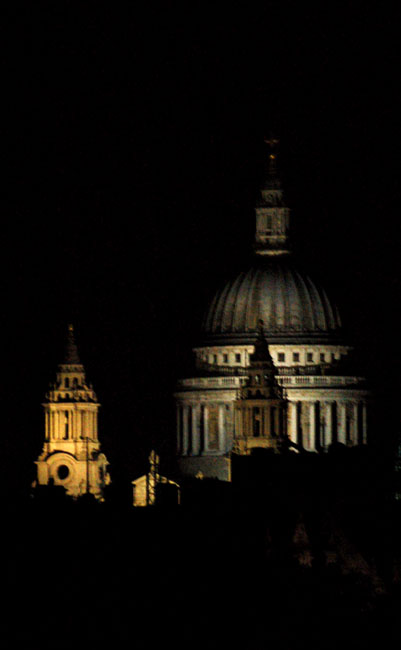
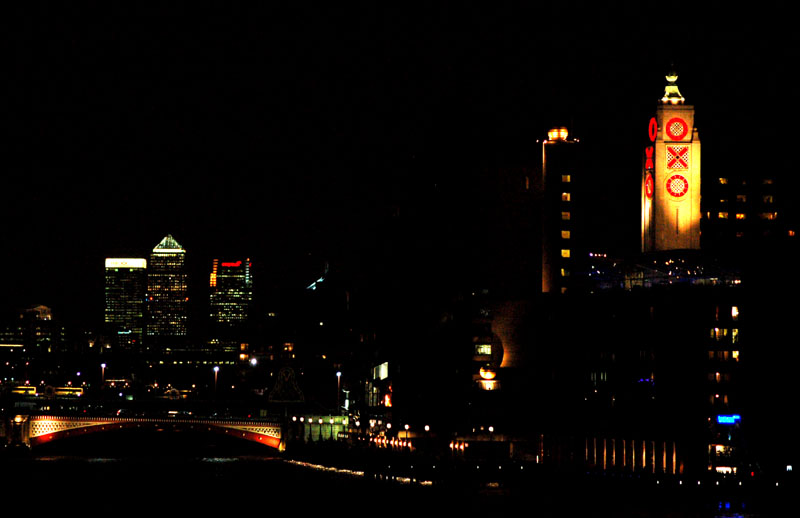
Outside, it was dark; I walked beside the Thames a little and went onto Waterloo Bridge, taking some pictures of London at night. St Paul’s looked spectacular – although it was a particularly cold light that illuminated the cathedral.


And then it was time to go to the jazz.
![[identity profile]](https://www.dreamwidth.org/img/silk/identity/openid.png)
no subject
Date: 2006-11-23 09:15 pm (UTC)